Aisha leaves Crimea to study in Ukraine
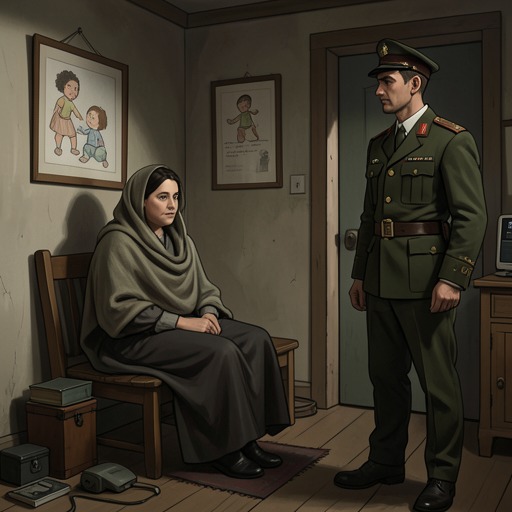
Grey BeesAisha leaves Crimea to study in Ukraine after her mother entrusts Sergeyich with helping her get out. The departure turns a private family decision into a journey negotiated through checkpoints, transport, and the practical care of strangers: Aisylu accompanies her daughter to the border, while Sergeyich carries her onward to the train for Vinnytsia and promises that Vitalina will meet her there.
Causes and decision
Aisylu’s request comes amid the family’s unsettled history. When Sergeyich first visits, Aisylu tells him that Akhtem has been taken and has been gone for twenty months. She later describes how three people who had travelled together to the mosque in Bakhchysarai disappeared; their car was found empty, and a child had seen them forced into a minibus. The uncertainty leaves the family without reliable answers about Akhtem’s fate.
The loss is not resolved by an official explanation. An official in Simferopol refers to Akhtem as Aisylu’s widow, then retracts the wording, saying the case is still open and that similar cases are beyond his office’s reach. When Akhtem’s body is eventually found buried in the woods, Aisylu thanks Sergeyich for going to Simferopol, saying that without his efforts Akhtem would not have been returned. That history forms the immediate background to her wish to get Aisha away.
Aisylu first considers whether money might help Bekir, but then makes a different request: she wants Aisha to leave. She proposes that the young woman go with Sergeyich, who is returning north, and suggests Vinnytsia as a destination. Aisylu and Sergeyich agree that they will raise money and get Aisha to the Ukrainian side of the border. Sergeyich says he is due to return soon and agrees to take her across; when Aisylu asks whether he will also help her continue to Vinnytsia, he finally answers yes.
Journey to the border
The arrangements depend on Sergeyich’s passage through a series of controlled crossings. On the way into Crimea, soldiers question his residence and inspect his passport and mobile phone. His account that he comes from Little Starhorodivka, near Karuselino, prompts them to check whether the village is in the D.P.R. Later, at the Russian checkpoint, he crosses a bridge and sees the sign for the Dzhankoy checkpoint, after passing a marker that counts eighteen kilometres back to the Russian occupiers. These checks make the border a concrete obstacle in the journey, not simply a line on a map.
On the return trip, Aisylu and Server follow Sergeyich to Bakhchysarai. At the city’s exit they pull over so Aisylu can embrace her daughter and whisper to her in Tatar. Sergeyich watches the farewell; Aisylu then nods to him to go on. The two women’s parting is intimate, but the journey continues through public spaces where each traveller must proceed separately.
Crossing and separation
At the border, Aisha joins the stream of people crossing on foot, carrying a green suitcase. Sergeyich sees her pass without turning her head and approach passport control, while he parks beneath the checkpoint canopy and goes to the window himself. After his own papers are checked, he drives slowly through the buffer zone, overtaking people on foot and looking among them for Aisha. He does not know whether she is still there or has already reached the Ukrainian border.
The separation is therefore practical as well as emotional: the two travellers move through the crossing by different routes, and Sergeyich can only search for her from his car. The checkpoint procedure leaves him uncertain about her progress until they meet again on the Ukrainian side. Aisha’s departure is not presented as a single passage through a gate, but as a sequence of waits, document checks, and attempts to remain in contact across the border space.
A route onward
After crossing, Sergeyich goes to the ticket window and asks for a seat to Vinnytsia. A place is available in carriage five, upper level, on a train departing in forty minutes. When he meets Aisha beside the carriage, her smile reassures him. He tells her to stay on the platform when she arrives and says that his wife, Vitalina, will meet her there; he gives her Vitalina’s phone number as a backup.
Aisha puts her suitcase and backpack on the train, then steps back down onto the platform. Sergeyich tries to reassure her about the journey, telling her not to be afraid and that the passengers are all right. The farewell thus includes more than the ticket itself: he gives her a named contact, a meeting plan, and reassurance before she boards for the long trip.
Significance and outcome
The departure links a family’s experience of disappearance and belated return to a concrete act of protection. Aisylu cannot remove the political uncertainty surrounding Akhtem or make Crimea feel secure for her daughter, but she can enlist Sergeyich to help Aisha leave. Sergeyich, who has himself been negotiating military and border controls, accepts responsibility beyond simply driving her to the Ukrainian side: he arranges her onward ticket and connects her to Vitalina in Vinnytsia.
The outcome is a departure rather than a fully narrated new life. Aisha boards the train, and Sergeyich remains behind; the evidence establishes the route and the plan for her arrival, not what follows in Vinnytsia. The scene’s decisive change is nevertheless clear: Aisha moves from her mother’s household in Crimea toward a new destination in Ukraine, supported by a chain of practical commitments that carries her beyond the border.